Sunday, December 12, 2010

Canaveral National Seashore


Today we went to see Turtle Mound which we discovered was located in Canaveral National Seashore park. The park located on barrier island is home to many species of plants and birds. The park has the longest undeveloped stretch of beach (24 miles) on the east coast of the state. The north portion of the park is connected to the southern portion by the beach only and has no through road.


Turtle Mound consists of more than 33,000 cubic yards of oyster and other shells, and covers nearly two acres (8,100m2) This prehistoric mound stands nearly 50 feet high and was constructed by the Timucuan Indians as far back as 800 to 1,400 AD.
There was a wooden walkway leading to the summit of the mound and on our way up we encountered this vulture who held his ground until we got very close.


On our drive we stopped to see what remains of the once thriving town of Eldora. The town was settled around 1877 with the settlers clearing the land, installing cisterns and planting crops. Some of the crops included pineapple, citrus, olives and vegetables.
Two years of killing frost in 1890 destroyed most of the citrus industry causing many of the residents to leave and by the turn of the century almost all business on the island had ended.
A few of the remaining residents kept their homes as vacation homes for many years but eventually this too ceased.
The Eldora State house has been restored and is now a museum to offer an example of the homes during the era when Eldora was a thriving community.
We drove out as far as the road extends on the north portion of the park and stopped for a short walk on the beach. During and for 48 hours after a successful space launch this section of the park is closed to the public. NASSA positions its northern most tracking device in this area during launches.

Saturday, December 11, 2010

Daytona Speedway


Today we took a tour of the Daytona Speedway, home of the Daytona 500, one of the most prestigious races in NASCAR. The track was built in 1958 to host the former Daytona Beach Road Course race and opened in 1959. 1958 was the last year that Daytonas race was held on the beach.
The track was designed to give spectators a better view of the race and to allow the cars to reach higher speeds.


The track features multiple layouts, the primary being the 2.5 mile (4.0km) high speed tri-oval. The tracks 180-acre infield also includes the 29-acre lake Loyd which was formed when millions of tons of soil was removed to help form the high banked turns on the track. The high water table in the area resulted in the hole quickly filling with water forming Lake Loyd.
In July of 2010 repaving of the track began and is expected to be completed by December 15 2010. Goodyear has scheduled a tire-test on the new surface for this date.

This tunnel runs under the track and is used to get people and vehicles to the track and infield.

Multiple garages are available for the drivers and their crew members and are assigned by the speedway.
This is one of the inspection stations where everything is weighed and measured to ensure that it meets the racing standards set by Daytona Speedway. The car is weighed with the driver inside it so even the drivers weight has to be accounted for.
We got to visit Victory Lane....notice the black marks left by the last winners tires.
We got to view the track from the press tower.


This is the official pace car for the Daytona 500 race in 2011.

Friday, December 10, 2010

Daytona Beach


We are in Daytona Beach nicknamed "The Birthplace of Speed". We drove on the world famous historic beach and although the speed limit was lower than the "greats" reached back in "The Day" it was quite a feeling.
The first historic race on this beach dates back to 1903 when Ranson E. Olds (father of the Oldsmobile) raced against and lost to Alexander Winton.
It was also on this beach that in 1935 Sir Malcolm Campbell posted an unprecedented official one mile speed of 276.82 miles per hour.
One of the spectators who witnessed Campbells record setting run was William Henry Getty France who would continue to usher in a new era of speed. In 1947 he and 18 other members of the racing Industry would come together to form the National Association of Stock Car Auto Racing (NASCAR). In 1948 France opened the 4.1 mile stretch of race track that ran north along the beach and south on Highway A1A near Ponce Inlet.


We drove on down to see the Ponce de Leon Inlet Lighthouse which has the distinction of being the tallest lighthouse in Florida at 175 feet (53m) high and its light can be seen 20 miles (32kms) away. In 1998 it was declared a National Historic Landmark.

The lighthouse was first constructed in 1883 and the lamp at that time was kerosene. The lighthouse was transferred to the Coast Guard in 1938 and they oversaw it for the next three decades. It was abandoned in 1970 and deeded to the Town of Ponce Inlet. The town made it and the surrounding caretakers buildings into a museum which is still open to the public today. In 1982 the lighthouse was restored to active service because high rise buildings were blocking the Coast Guard's beacon on the other side of the inlet.
Sunday, December 5, 2010

Jacksonville Florida


We have finally made it to Florida and are now in Jacksonville. We are staying at Pecan Park RV. It is a huge park...600+ sites, swimming pool and nice clubhouse.
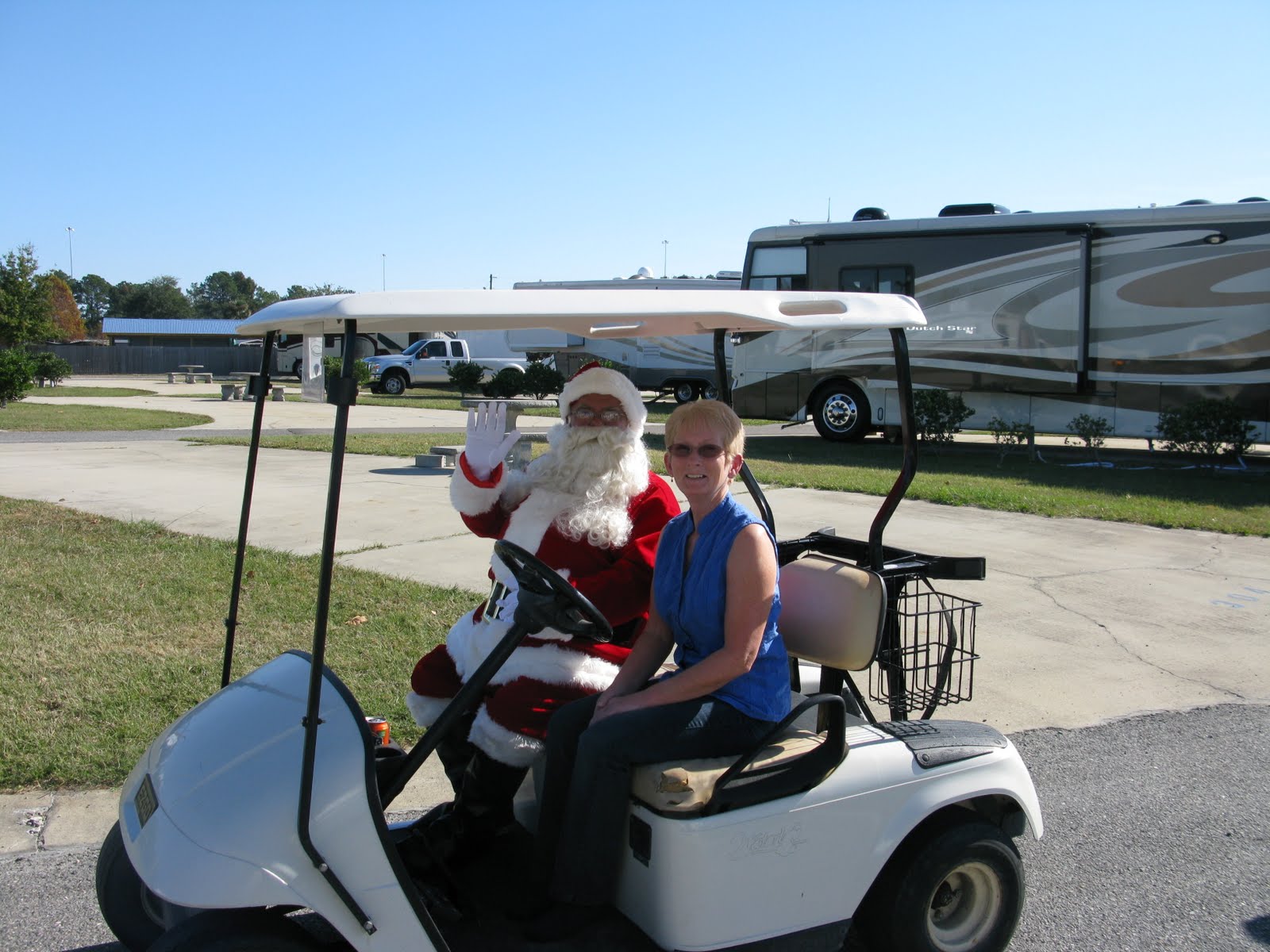
Santa is already here...says it is too cold up in the North Pole so he is hanging out here till the big day.
Today we went for a short drive to see the Atlantic Ocean at Fernadina Beach. It was beautiful and the sand is very fine...almost like ash in texture. Molly was so excited!

On the way back to the motorhome we finally got to see an armadillo that was on a quiet enough road that we could stop and take a picture. He just posed so nicely for me...so cute.

Wednesday, December 1, 2010

The Incline Railway, Chatanooga Tennessee Nov 27


Called America`s Most Amazing Mile the Incline Railway opened on November 16 1895. Known simply as `The Incline` the railroad rises up the steepest part of Lookout Mountain and boasts an incline of 72 percent at the steepest part of the track. I certainly believe it as we were slipping out of our seats. It is used not only as a tourist attraction but also as a means of transportation to get people and sometimes freight up and down the mountain. Originally the cars were made out of wood but are now made out of steel and are built on an angle to allow the passengers to be more comfortable on the ride. Notice the angle that the car sits or should I say perches at when it is at the top of the mountain.


The view from the top of the mountain was spectacular and you could see for miles.

I am not sure if you can see the angle of the track out the front window of the train car but it was pretty much staight down.


On the way back to the motorhome we saw this pick up truck along the side of the highway engulfed in flames.